
Cervical radiculopathy, a pinched nerve root in the neck, causes arm symptoms that follow a map. The map tells you which level of the neck is involved.
What it is
A nerve root leaving the neck (the cervical spine) gets squeezed. The cause is a disc herniation (a bulging or torn disc) or bone narrowing the foramen, the small opening the nerve passes through.
C6 sends symptoms to the thumb, C7 to the middle finger, C8 to the little finger. Doctors use this pattern to find the level in the exam room.
How it usually presents
- Neck pain with arm pain. The arm often hurts more than the neck.
- Numbness or tingling in specific fingers.
- Weakness in one movement: bending the elbow, straightening the elbow, or grip.
- Relief when you rest your hand on top of your head.
How we treat it
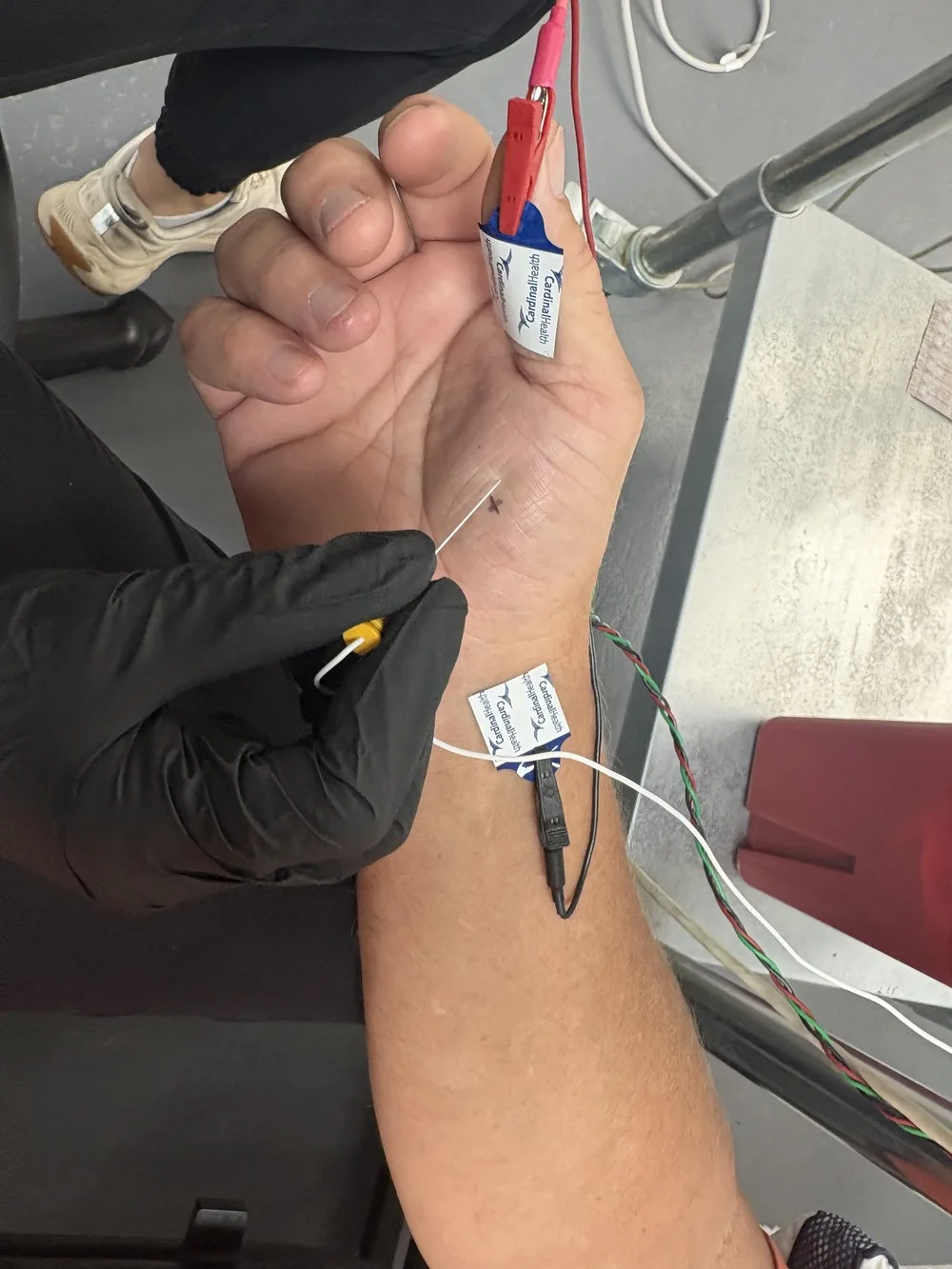
- An exam. If the answer is unclear, an EMG test to tell a nerve root problem from a peripheral nerve problem (a nerve out in the arm or hand).
- Cervical epidural steroid injection.
- Physical therapy including traction (gentle pulling on the neck) when it fits.
To get checked, call us or request an appointment. If this began with a crash or a fall, see accident and injury care.
What usually gets missed
Cervical radiculopathy is often mistaken for a shoulder problem, a carpal tunnel problem, or both at once. And patients can truly have two of them at the same time. That is where diagnosis gets hard.
What settles it is where the numbness falls, not where the pain is. C6 takes the thumb, C7 the middle finger, C8 the little finger. Carpal tunnel takes the thumb, index, middle and half the ring finger. It almost always leaves the little finger alone. When the story is unclear, nerve conduction testing sorts them out with hard data.
What to expect over time
The usual course is better than most patients expect. Most cases of cervical radiculopathy get much better within a few months without surgery. The arm pain usually settles before the numbness does.
Some numbness left in a strip of skin after the pain is gone is common. It is not a sign of failure. Muscle weakness that is not coming back, or that is getting worse, is different. That is the finding that calls for a referral to a surgeon, not more time.
When this becomes urgent
Symptoms in both arms, or in the legs as well, suggest cord compression (pressure on the spinal cord itself), not a single root. These need a prompt check. So does a hand that keeps getting clumsier, like dropping things or trouble with fine tasks, or a change in walking.
Related: arm numbness that does not follow a nerve root map can be thoracic outlet syndrome.
Common questions
Is this the same as carpal tunnel?
No, though people mix them up all the time. Carpal tunnel is pressure on a nerve at the wrist. EMG tells them apart reliably.
Sources
- Woods BI et al. Cervical radiculopathy: epidemiology, etiology, diagnosis, and treatment. Journal of spinal disorders & techniques, 2015. PubMed 25985461
- Childress MA et al. Nonoperative Management of Cervical Radiculopathy. American family physician, 2016. PubMed 27175952
- Iyer S et al. Cervical radiculopathy. Current reviews in musculoskeletal medicine, 2016. PubMed 27250042
- Borrella-Andrés S et al. Manual Therapy as a Management of Cervical Radiculopathy: A Systematic Review. BioMed research international, 2021. PubMed 34189141
Hurt in an accident? Start here.
You do not need a lawyer, a police report or a referral to be seen. Bring your symptoms and we will work out the rest.
Monday–Friday, 8:00 a.m. – 4:00 p.m. Same-day appointments are often available for new accident and injury patients.