
Cervical radiculopathy is a pinched or inflamed nerve root in the neck. It sends pain, numbness or weakness down one arm into particular fingers. Most cases settle without surgery over a few months. Treatment calms the root with a targeted injection, therapy and time, after testing confirms which root it is.
Cervical radiculopathy, a pinched nerve root in the neck, causes arm symptoms that follow a map. The map tells you which level of the neck is involved.
What is happening to the nerve root?
A nerve root leaving the neck (the cervical spine) gets squeezed. The cause is a disc herniation (a bulging or torn disc) or bone narrowing the foramen, the small opening the nerve passes through.
C6 sends symptoms to the thumb, C7 to the middle finger, C8 to the little finger. Doctors use this pattern to find the level in the exam room.
How does a pinched nerve feel different from a stiff neck?
- Neck pain with arm pain. The arm often hurts more than the neck.
- Numbness or tingling in specific fingers.
- Weakness in one movement: bending the elbow, straightening the elbow, or grip.
- Relief when you rest your hand on top of your head.
Why does the arm hurt so much when the scan looks mild?
Because squeezing is only half of it. A nerve root that is pressed but not inflamed tends to go numb, not hurt. Pain needs a second ingredient. When a disc tears, its soft center leaks chemicals that inflame any root they touch. An inflamed root fires at the slightest stretch. That is why a modest bulge can cause severe arm pain, why a huge one can cause none, and why an anti-inflammatory epidural can work when nothing has physically moved.
The resting-hand sign follows from the same physics. Lifting the hand onto the head slackens the root, so it stops being tugged each time the arm hangs.
Two biological drivers, then: pressure from bone or disc, and chemical inflammation of the root. The third driver is the life around the neck. Hours of overhead work with the head tipped back, painting a ceiling or reaching into an engine, close the opening the root passes through. Fear of moving keeps the neck braced. Money matters too. In a review of people with a symptomatic cervical disc herniation, those with a workers’ compensation claim did worse (Wong and colleagues, 2014). The disc is no different. The pressure to get back to work, or to prove the injury, is.
How is the right nerve root confirmed?
The exam names a suspect: which fingers are numb, which reflex is weak, which muscle gives way. Raising the arm overhead or tilting the head toward the bad side tells us how irritable the root is.
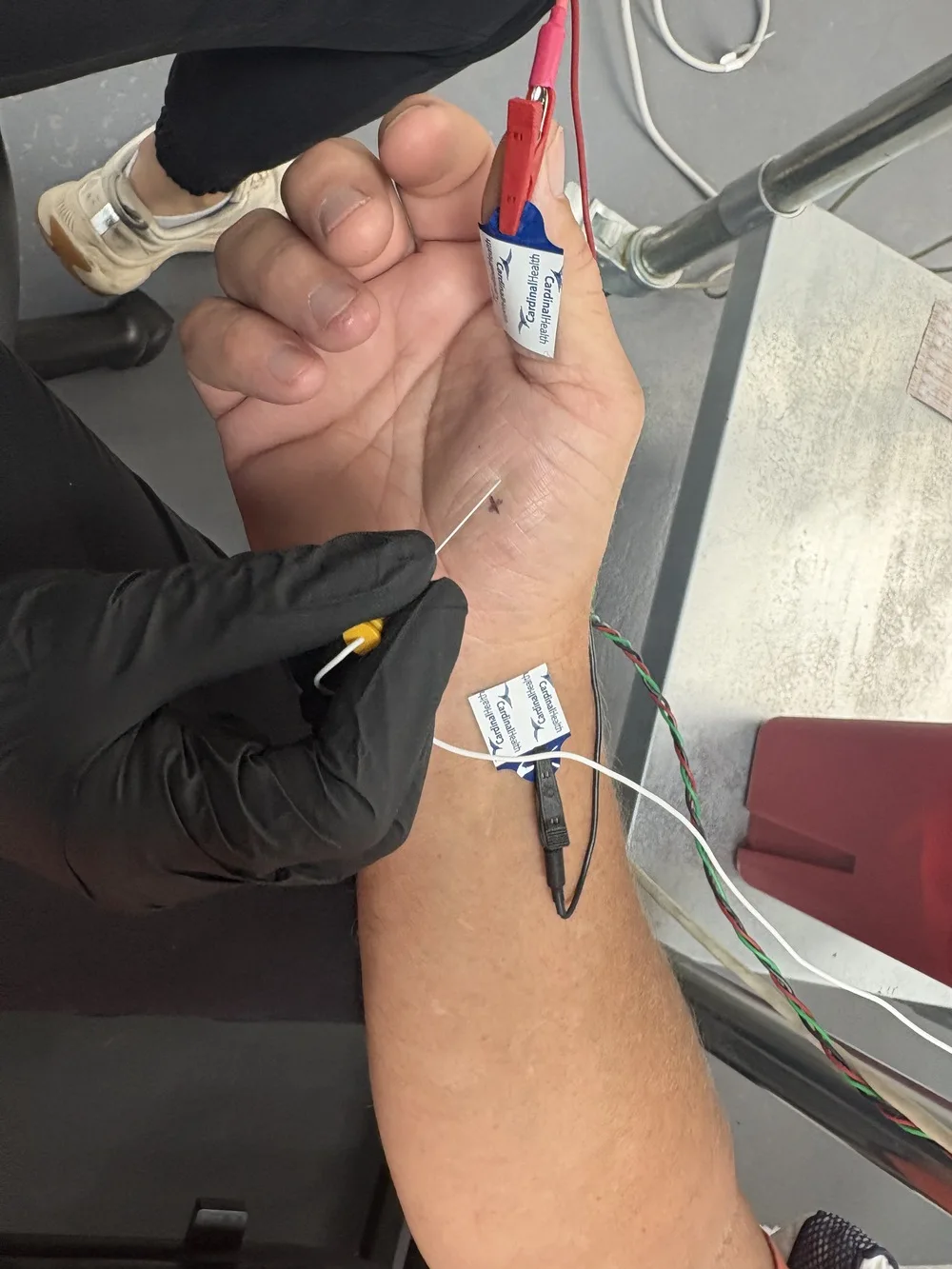
An EMG and nerve conduction study comes next when the picture is mixed. It shows whether the problem is at the root, at the elbow or at the wrist, and whether the nerve has lost connections to its muscles. The muscle changes take a few weeks to appear, so the test is most useful after that point.
An MRI is ordered when weakness is present or an injection is being planned, because the needle needs a map. A selective nerve root block can then settle a close call between two levels. Numbing one root and watching the arm pain stop is direct proof.
Dr. Padda has tested that rule on his own body, and not gently. He ran a sauna heat study on himself, drew his own blood and wore a heart monitor through it. He pushed hard enough to trigger bigeminy, an irregular rhythm where every other beat comes early, and reversed it with a cold plunge. The habit he took from it is to measure first and decide second. A nerve gets the same treatment here: strength, reflexes and a nerve study, not a judgment based on how the arm feels on a good day.
What calms an irritated nerve root?
- An exam. If the answer is unclear, an EMG test to tell a nerve root problem from a peripheral nerve problem (a nerve out in the arm or hand).
- Cervical epidural steroid injection.
- Physical therapy including traction (gentle pulling on the neck) when it fits.
The epidural places steroid at the inflamed root through a transforaminal approach or between the vertebrae. It is done awake, with numbing medicine and no sedation, under live X-ray. Most people are back to normal activity, including work, within two to four hours. The one reason to bring a driver: the arm can feel heavy or numb for a few hours afterward. If it does, someone else drives until it wears off.
Injections are repeated only when the first one helped and the pain returns, not on a fixed schedule. Nerve pain medicines help some people sleep through the worst weeks. Sleep matters because a sleep-starved spinal cord amplifies every signal from that root. Therapy reloads the neck as the arm settles. Acceptance and commitment therapy, delivered in-house, helps when fear of the pain has started running the day.
PRP does not treat a pinched nerve root. Many of the same patients also have a worn shoulder or a sore tendon riding along, and that part may suit an injection described on the orthobiologics page.
To get checked, call us or request an appointment. If this began with a crash or a fall, see accident and injury care.
Could it be carpal tunnel or a shoulder problem instead?
Cervical radiculopathy is often mistaken for a shoulder problem, a carpal tunnel problem, or both at once. And patients can truly have two of them at the same time. That is where diagnosis gets hard.
What settles it is where the numbness falls, not where the pain is. C6 takes the thumb, C7 the middle finger, C8 the little finger. Carpal tunnel takes the thumb, index, middle and half the ring finger. It almost always leaves the little finger alone. When the story is unclear, nerve conduction testing sorts them out with hard data.
How long does a pinched nerve in the neck take to heal?
The usual course is better than most patients expect. Most cases of cervical radiculopathy get much better within a few months without surgery. The arm pain usually settles before the numbness does.
Some numbness left in a strip of skin after the pain is gone is common. It is not a sign of failure. Muscle weakness that is not coming back, or that is getting worse, is different. That is the finding that calls for a surgical opinion, not more time.
The best summary of the research on cervical disc herniations with radiculopathy found that most people start with intense pain and real disability, improve a great deal within four to six months, and that about 83% recover completely over two to three years (Wong and colleagues, 2014). That review leaned on only three low-bias studies. The direction is still clear: this is a condition that mostly heals.
When does a pinched nerve need an operation?
When weakness is getting worse, when the spinal cord is under pressure, or when arm pain stays severe after months of injections, therapy and time. Pooled trials of cervical spondylotic radiculopathy, 6 studies with 464 people, found surgery relieved arm and neck pain faster in the first year. They also found no clear difference in disability at twelve months (Luyao and colleagues, 2022). Speed is the real trade. At that point the next step is a surgical opinion from Dr. Gurpreet Singh Padda, MD, MBA, MHP, who is a licensed surgeon as well as a pain physician. If a fusion is ever the right operation, we coordinate it with a spine surgeon and continue your pain care around it.
When this becomes urgent
Symptoms in both arms, or in the legs as well, suggest cord compression (pressure on the spinal cord itself), not a single root. These need a prompt check. So does a hand that keeps getting clumsier, like dropping things or trouble with fine tasks, or a change in walking.
- Emergency department: new weakness in an arm or leg after a fall, or any loss of bladder or bowel control.
- Same day: arm pain with fever, or after a recent infection or injection anywhere in the spine.
- Same day: arm or jaw pain with chest pressure or shortness of breath. The heart can mimic a C6 or C7 root.
- Soon: a muscle that is visibly shrinking, such as the web between thumb and index finger.
Related: arm numbness that does not follow a nerve root map can be thoracic outlet syndrome.
Common questions
Is this the same as carpal tunnel?
No, though people mix them up all the time. Carpal tunnel is pressure on a nerve at the wrist. EMG tells them apart reliably. How the nerve study works is laid out step by step.
Do I need a referral to be seen for a pinched nerve?
No. You can book yourself in. Some insurance plans do ask for a referral from your primary doctor before they pay, and we can check yours when you call. The new patient page lists what to bring.
Will the numbness in my fingers go away?
Usually, but last. Pain tends to fade first, then strength returns, and numbness lingers longest. A small patch can stay for good without meaning anything is wrong. Foraminal narrowing explains the opening the root has to pass through.
Can I drive home after a cervical epidural?
Most people do, because there is no sedation. If your arm feels weak or numb afterward, have someone else drive until it passes. The epidural page covers the day in detail.
Sources
- Woods BI et al. Cervical radiculopathy: epidemiology, etiology, diagnosis, and treatment. Journal of spinal disorders & techniques, 2015. PubMed 25985461
- Childress MA et al. Nonoperative Management of Cervical Radiculopathy. American family physician, 2016. PubMed 27175952
- Iyer S et al. Cervical radiculopathy. Current reviews in musculoskeletal medicine, 2016. PubMed 27250042
- Borrella-Andrés S et al. Manual Therapy as a Management of Cervical Radiculopathy: A Systematic Review. BioMed research international, 2021. PubMed 34189141
- Wong JJ, Côté P, Quesnele JJ, Stern PJ, Mior SA. The course and prognostic factors of symptomatic cervical disc herniation with radiculopathy: a systematic review of the literature. Spine J. 2014;14(8):1781-9. Adults with symptomatic cervical disc herniation and radiculopathy; best-evidence synthesis of 3 low-bias studies. PMID 24614255. doi:10.1016/j.spinee.2014.02.032
- Luyao H, Xiaoxiao Y, Tianxiao F, Yuandong L, Wang P. Management of Cervical Spondylotic Radiculopathy: A Systematic review. Global Spine J. 2022;12(8):1912-1924. 6 randomized trials, 464 participants, surgery versus conservative care. PMID 35324370. doi:10.1177/21925682221075290
Hurt in an accident? Start here.
You do not need a lawyer, a police report or a referral to be seen. Bring your symptoms and we will work out the rest.
Monday–Friday, 8:00 a.m. – 4:00 p.m. Same-day appointments are often available for new accident and injury patients.